The first time I unloaded a 20 foot inflatable water slide at 7 a.m. on a July Saturday, the street was already shimmering. Parents hauled coolers, kids hovered at the end of the driveway in swim shirts, and inside the truck the industrial blower waited like a coiled dragon. Thirty minutes later the slide stood tall, a rainbow stripe against the heat, and those kids went non stop for six hours. That’s the magic of a great water slide rental. You get a crowd pleaser that cools everyone down, keeps the party moving, and photographs beautifully.
If you’ve never booked one, the choices can feel like alphabet soup. There are single lane and dual lane, slip n slides with splash pads, slides with bounce houses attached, steep “drop” slides, tropical themes, arctic themes, and plenty of hybrids. After a decade of setting them up for backyard party rentals, school field days, block parties, and last minute birthday saves, I’ve narrowed the field to ten water slide styles that consistently deliver. I’ll also share sizing tips, safety notes, and small details that separate a smooth rental from a stuttered one.
What makes a water slide rental worth it
The best water slides match the age group, yard space, water pressure, and party rhythm. If you’re hosting a mix of 5 to 8 year olds, you want lower height and softer slopes. If you’ve got teens, you want speed, dual lanes, or an inflatable obstacle course rental nearby to rotate in. I ask customers about their hose pressure, gate widths, and sun exposure because this changes the experience. Low water pressure calls for a slide with a good overhead sprayer bar rather than tiny misters, and a narrow gate eliminates certain larger models.
Many families also add a kids party inflatable or birthday party bounce house to cover downtime between slide cycles, especially if you expect little cousins or a few kids who haven’t warmed up to sliding yet. A local bounce house company that offers both a water slide rental and an inflatable game rental can bundle delivery and monitor the setup more efficiently.
The top 10 water slide rentals that deliver a great day
I’m listing these as types rather than proprietary names, since every region renames them. Most reputable companies carry versions of these. I’ll note typical heights, footprints, age ranges, and what kind of party they fit.
1. 15 to 16 foot single lane classic
The workhorse for birthday parties and family cookouts. Most models run about 15 feet tall, 25 to 28 feet long, and 9 to 11 feet wide. They fit a standard suburban yard and clear most trees and power lines. Kids as young as 4 can ride with a parent’s spot, and 10 year olds will loop endlessly. The climb is manageable and the slope gentler than taller slides, which limits wipeouts and keeps the splash pool tame.
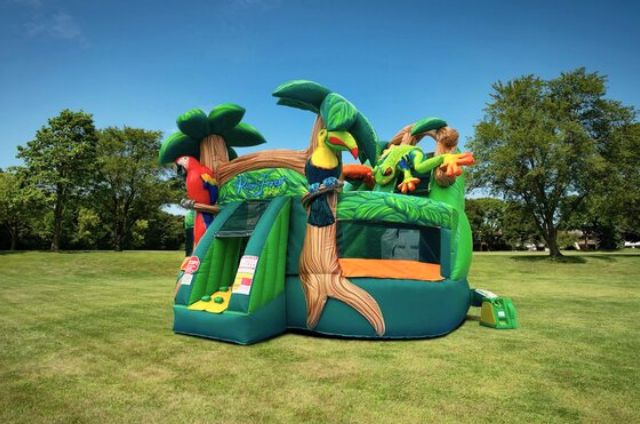
I’ve set this slide at at least a hundred birthdays. It’s forgiving when you’re not sure who is coming. With a single lane, lines move slower than dual lane models, but for groups under 12 it’s fine. For themes, the tropical palm look blends into summer decor and photographs well.
2. 18 foot single lane with deep pool
This is the sweet spot for mixed ages. The footprint grows to around 30 to 35 feet long with a wider pool. The extra height adds speed and a bigger splash, which keeps older siblings happy. You’ll want clear access from the street to the yard and a gate opening roughly 40 inches or wider. Many 18 footers include a built in overhead sprayer that spreads water evenly without relying on high pressure, which helps in neighborhoods with older plumbing.
If you can stretch the budget a bit, this often beats stacking multiple smaller inflatables. I’ve paired it with an inflatable bounce house in the front yard for variety. Kids hop between dry bouncing and wet sliding and you avoid bottlenecks.
3. Dual lane 18 to 20 foot race slide
When I hear “we’ve got 20 kids between 7 and 13,” I recommend a dual lane. Two lanes mean constant motion. Races work naturally without adult micromanagement, and the slide’s throughput doubles, which reduces crowding and keeps the energy positive. Width jumps to about 15 feet, sometimes more, so measure carefully. The pool can be shared or split, but either way you need more water flow to keep both lanes slick.
One practical note: dual lanes eat hose pressure. If your outdoor spigot dribbles, ask the rental company to bring a splitter and run a second hose from another spigot, or choose a model with an integrated spray bar across both lanes. If the company also offers a jumper rental on site, assign that to the smaller kids so the big kids have their race lane time.
4. Hybrid bounce and slide combo with splash pad
For families with toddlers and early elementary school kids, a combo unit is gold. These inflatable bounce houses include a small climb and slide that ends in a shallow splash pad instead of a deep pool, which reassures cautious kids and makes it easier for parents to hover nearby. Most combos run about 13 by 25 feet in footprint and only 12 to 14 feet tall, so they fit under lower tree canopies.
I like these for first birthdays with older cousins, or backyard party rentals where you need one piece to do two jobs. The bounce area can be used dry early in the day, then you hook up the water when the sun gets hot. Because it’s not as water intensive as a full slide, it suits tighter neighborhoods where run off matters.
5. 22 foot drop slide for teens
When your guest list trends older, height transforms the vibe. A 22 foot drop slide brings a steeper face and faster ride, often with a hump that keeps the thrills up. The base pool is deeper and longer. Plan for a significant footprint, up to 36 or even 40 feet long, plus anchor space and blower clearance. You’ll also need a truly level area. On slopes, taller slides can lean or feel sketchy, and the installer should refuse if they can’t anchor safely.
I recommend these for graduation parties, large family reunions, or a summer block party where you want a centerpiece. Because they attract risk takers, I like pairing this with a clear rules sign and a volunteer rotation. No pushing, no flipping, no headfirst slides. A good event inflatable company will provide signage and go over safety face to face.
6. Tropical curve slide with splash trough
Not every yard has the straight shot to fit a long runout. Curved slides solve that. The slide veers gently left or right and empties into a trough style splash area instead of a square pool. This uses yard depth more efficiently and feels distinct from the standard straight layout. Heights range from 15 to 20 feet. Curves also reduce line-of-sight monotony and make it easier to supervise, since the pool sits closer to the climb ladder.
One summer we installed three curved slides end to end around a U shaped yard for a neighborhood fundraiser. It moved people smoothly, minimized congestion, and turned a narrow space into a fun circuit. If your patio intrudes on the usable lawn, a curved slide is often the best fit.
7. Slip n slide with splash zone
For long, narrow yards or driveways, the classic slip n slide style inflatable still earns its keep. These are typically dual lane, 30 to 35 feet long, and only 8 to 10 feet wide. Riders dive onto a slick runway and glide into a splash pad. There is no tall climb, which keeps the line moving and lowers risk. Water demand is steady but not brutal.
This is also a good add on next to a dry inflatable game rental such as a soccer darts or basketball shooter. Kids will sprint between the two without much supervision. If your group skews younger, you need a clear rule about belly slides only and no runs that start outside the mat. A little coaching at the start pays off in fewer grass burns and safer fun.
8. Arctic plunge with extended runout
Some slides include an extended runout after the slope that keeps riders moving along a slip section before they hit the water. This design lowers impact for mixed age groups and stops the “pile up” that happens when kids sit in the pool. Height ranges from 18 to 22 feet, but the total length can exceed 40 feet. It looks impressive and handles a lot of kids without chaos.
Parents who care about photo angles love this model. The long runout frames riders, and you get great action shots from the side. If you’re coordinating a school event, two of these in parallel means teachers can staff only the ladders and let the landing area manage itself.
9. Mega dual lane with detachable slip n slide
Think of this as a festival piece. A tall dual lane slide attaches to a matching dual lane slip n slide, creating a ride path that continues after the drop. The overall length can hit 50 feet or more. It’s a huge footprint, a big water commitment, and a magnet for teens. You’ll want a large, flat lawn free of sprinkler heads and tree roots, plus a clear cart path from the curb because these units can weigh several hundred pounds rolled up.
We book these for corporate picnics and HOAs with common green spaces. Throughput is excellent and downtime is rare. If you only have one hose spigot, ask your local bounce house company whether they bring a Y adapter and additional hoses to feed both sections. With some brands, a single feed underperforms and you get dry patches halfway down.
10. Toddler friendly mini splash slide
Toddlers deserve their own spot. A mini splash slide, often 10 to 12 feet tall with a shallow landing pool, gives tiny riders a space with control. Older kids get bored quickly, which is exactly the point. If your party includes toddlers and elementary kids, set this mini slide near the adults’ seating area and put the larger slide across the yard. An indoor bounce house rental can also work if the forecast looks stormy and you need a backup plan, since many toddler inflatables can be used dry in a garage or community hall.
I’ve seen more toddler smiles on these little slides than any other inflatable. Shorter climbs help kids who struggle with tall ladders, and parents can spot from the side without hovering on the steps.
Choosing the right size for your yard
Before you book, pull a tape measure and sketch your space. Inflatable slide rental specs list length, width, and height. You also need 3 to 5 feet on each side for anchor straps and blower access. A blower needs a standard outlet on a dedicated circuit within 75 to 100 feet. If you plan to run two blowers, consider two separate circuits. Nothing tanks a party faster than tripping a breaker every ten minutes.
Gate width catches people by surprise. Many rolled slides are 36 to 48 inches wide when strapped, and some weigh 300 pounds. If your side gate is narrow or your yard is only accessible by stairs, say so up front. A reputable event inflatable company will steer you to models that fit or suggest an alternative, like setting up in the front yard and roping off the area.
Sun exposure matters too. Dark vinyl heats up and can become uncomfortable to touch in direct afternoon sun. Ask for a lighter color palette or a shade canopy over the ladder if your yard bakes. I’ve tossed white towels over hot handholds mid day and kept kids moving safely.
Safety details that smart hosts prioritize
Water slides are safe when rules stick and equipment is anchored right. Every serious operator uses stakes or sandbags rated for the slide’s size, tethers the top points, and checks the seams before kids ride. If the day is gusty, there’s a wind speed threshold where they will shut it down. I keep a pocket anemometer for borderline situations. If your vendor waves through high winds or ignores a slope, that’s a warning sign.
Rider rules are simple: one at a time per lane, feet first, no flips, no climbing the slide face, and no roughhousing in the pool. For mixed ages, designate windows. Five minutes for tiny kids, then five minutes for bigger kids. Put a tall chair by the ladder and rotate an adult. The person at the ladder controls the whole tempo by sending riders at safe intervals.
Hydration sneaks up on kids who run wet. Set a water table away from the slide so drips don’t muddy the cord path. I also require break windows during peak heat. Ten minutes off the slide at the top of the hour seems small, but it cuts down on meltdowns and skinned knees.
Water use, drainage, and neighborly planning
A typical water slide uses a gentle, continuous flow. Think garden shower rather than fire hose. Expect 2 to 4 gallons per minute for single lane models and more for dual lane or combined systems. Over four hours, that adds up. If you’re drought conscious, choose models with overhead spray bars and splash pads instead of deep pools. You can also throttle the hose slightly and keep the vinyl slick without waste.
Plan where the water will go. Direct run off away from foundations and mulch beds. If your yard slopes toward a neighbor’s fence, lay out a small channel with landscape edging or old towels to slow the flow. Some customers connect the pool drain to a short hose and route it to a lawn that needs watering. Ask your vendor whether the pool has a built in drain cap you can manage.
Cleanliness and sanitization you can verify
Most local operators clean between rentals, but methods vary. Don’t be shy about asking how they sanitize. I look for non chlorine disinfectants that are safe for vinyl, followed by a freshwater rinse, then full dry time. If a company shows up with a wet slide at 9 a.m. on a dewy lawn, it likely wasn’t fully dried overnight and may have trapped moisture, which can lead to odor or mildew. Quality outfits carry clean towels, extra tarps, and a small blower for drying the ladder and pool before kids mount up.
Pro tip: request a tarp under the climb side and the pool. It keeps mud at bay and makes pickup easier. If you’re renting a birthday party bounce house in addition to the slide, have the bounce house placed on a second tarp to avoid tracking wet grass into the dry unit.
How to pair a slide with other inflatables without chaos
One water slide carries a party by itself, but pairing it with another piece covers more ages and prevents long lines. I like a simple mix: a water slide in the back and an inflatable bounce house or bouncy castle rental in the front. It creates two zones, which spreads noise and keeps wet and dry traffic separate. For large groups, add an inflatable obstacle course rental to burn energy in timed heats. Courses run well in three minute intervals while the slide continues as a free ride.
If your local bounce house company offers package pricing, ask for a water slide rental plus one party inflatable rental and one inflatable game rental. The game can be a quick-wins station, like axe toss foam or a hoop shoot, which occupies kids who need a break from getting soaked.
Budgeting, deposits, and what a fair price includes
Pricing varies by region and season. For a 15 to 16 foot slide, expect a day rate in the low to mid hundreds. An 18 to 20 foot single lane often lands a tier higher. Dual lanes and mega units cost more, sometimes approaching four figures for a full day, especially on holiday weekends. That price should include delivery, setup, stakes or sandbags, a blower, a hose misters line or sprayer, and pickup. Ask about power cords and hose length, because some companies charge for extra.
Deposits are standard. Weather policies matter more. A customer friendly company will allow rescheduling or a refund if storms or high winds make operation unsafe. If you’re planning weeks out, place a deposit early for prime dates and set a reminder to confirm three days prior.
The setup timeline and what to prep ahead
Professionals can set a single slide in 20 to 40 minutes if the path is clear. Clear toys, pet waste, sprinkler heads, and furniture before they arrive. Mark any underground lines if you know them. If the slide will sit near a pool, make sure there is enough room to anchor without crossing the pool deck, since anchors in concrete require special hardware and permissions.
I like to run electrical and hoses on opposite sides of the yard, then tape or stake cords down where foot traffic crosses. Keep a ground fault interrupter in line for extra safety. When the crew tests the slide, watch where water pools and make small adjustments before the grass gets saturated.
When indoor rentals make sense
Summer weather sometimes wins. If a storm system parks overhead, an indoor bounce house rental in a gym, hall, or garage can rescue a birthday. Some combo units can run dry indoors with headroom of 14 feet, but water slides do not belong under a roof. If your date sits in a volatile season, ask whether the company allows swapping a water slide rental for a dry inflatable on the morning of delivery if rain looms. Many will accommodate if inventory allows.
A quick buyer’s shorthand for matching slide to party
Sometimes you just want a fast answer. If your guest list is mostly 4 to 7 year olds and your yard is average size, choose the 15 to 16 foot single lane or a bounce and slide combo with splash pad. If the crowd is mixed ages up to party rentals with setup 12 and you have a little more room, book an 18 foot single lane with a deeper pool. If teens dominate, pick a 22 foot drop slide or a dual lane model. If you need to move a line efficiently, dual lanes beat single every time. If your yard is narrow, consider a slip n slide or a curved slide. For toddlers, add a mini splash slide and a small inflatable bounce house on the side.
The small touches that turn a good rental into a great day
After hundreds of setups and just as many take downs, I’ve learned that little things make the day smoother. Bring a tote with extra beach towels, sunscreen, and a soft bristle brush to sweep grass from the pool floor. Place a shoe rack and a small bench near the ladder. Put a “start here” sign at the bottom and a “wait for all clear” sign at the top. If your neighborhood has strict parking, reserve a spot for the delivery truck by setting out cones early. Let the crew walk the route, point out sprinkler heads, and suggest a final placement before they unroll.
And enjoy the looks on faces the first time the blower roars and the vinyl climbs into the sky. It still gives me a jolt. A well chosen water slide rental does more than fight the heat. It turns a backyard into a destination, gives kids a safe place to be loud, and buys parents a few hours to laugh together under a shade tree.
Below is a short pre flight checklist you can use on booking day.
- Measure length, width, and height clearance, plus gate width, and note outlets and hose spigots. Ask the local bounce house company about water flow requirements, anchoring method, and cleaning process. Confirm weather policy, delivery window, and whether tarps and extension cords are included. Plan traffic flow: wet zone, dry zone, and a spot for towels and shoes. Assign an adult to the ladder and set simple rules: feet first, one at a time, and safe spacing.
With the right match between space, age group, and slide style, you’ll get a party that practically runs itself. And when the last rider hops off and the blower goes quiet, the yard feels bigger, the air cooler, and you’ll be glad you didn’t settle for cold popsicles alone.